How to Pan and Photograph Fishing Boats in Motion
Fishing boats do not perform. A trawler easing past the harbour mouth at first light moves with the patience of something that has done this ten thousand times; then the skipper opens the throttle, the bow lifts, and the water behind the transom turns white. That moment — slow, then committed — is exactly why working boats reward a photographer who understands panning. They give you time to prepare, a clear line of travel, and a hull full of texture: rust streaks under the rails, coiled netting, faded registration numbers, a wheelhouse window catching the sky. Get the technique right and you come back with images that feel like the harbour itself, not like a boat show.
Read the boat before you lift the camera
Give yourself two or three minutes of pure watching before you touch the settings. Ask what the boat is about to do. A vessel leaving the quay has to clear moorings, turn, and settle into the channel; a boat coming home is heavy, sitting low, often pushing a much bigger bow wave than it did on the way out. Both are predictable, and predictability is what you need.
Watch the water too. A boat running against the swell will pitch and roll, so your framing has to breathe with it. A boat running with the swell looks unnaturally steady and the wake stretches out behind in a long, clean line — good for dramatic pans, bad for dramatic spray. Also check the channel markers and breakwater gaps. Larger trawlers keep to a lane, which means you can choose a vantage point and let them come to you instead of chasing along the quay.
Choose the shutter speed first
Everything else follows from the effect you want. Decide whether the boat should be frozen, or whether the water and background should smear while the hull stays readable. Then set the shutter and let the camera sort out the rest — auto ISO with an upper limit you're comfortable with will do the job in changing harbour light.
- 1/1000 to 1/2000 — freezes everything, including spray and the flick of a bow wave. Useful for head-on approaches and for crew working on deck.
- 1/500 to 1/800 — the safe, workmanlike setting. Boat sharp, water alive, background still recognisable.
- 1/250 to 1/320 — the boat stays crisp if your pan is good and the background begins to streak. My own default for harbour work.
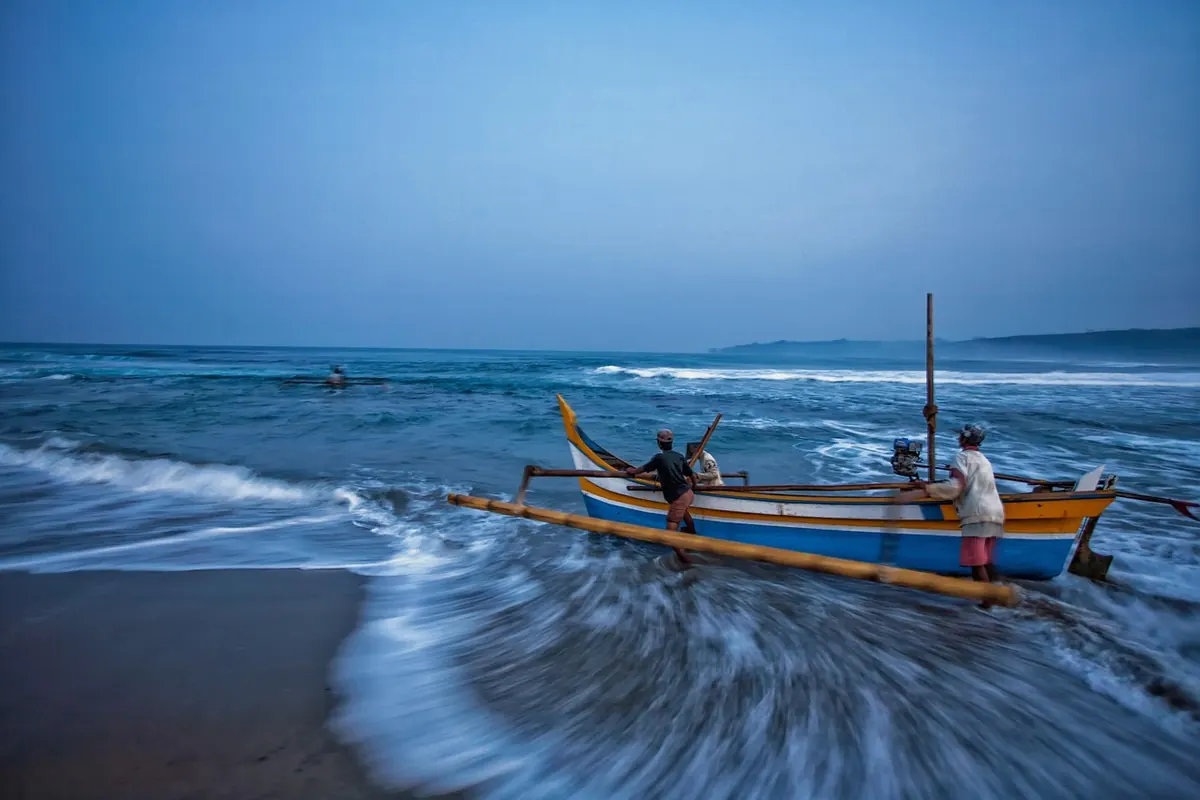
- 1/60 to 1/125 — full panning territory. Hull and wheelhouse readable, quay and hillsides turned into soft bands of colour.
- 1/15 to 1/30 — for slow trawlers at dusk, and for the pleasure of a few lucky frames. Expect to throw most of them away.
Two practical notes. Long lenses magnify movement, so a 200mm pan at 1/125 is far harder than a 50mm pan at the same speed; start wide and work your way in. And if your lens or body has a stabiliser with a dedicated panning mode, use it — it corrects vertical shake while leaving the horizontal smear intact.
The pan itself, step by step
Panning fails for boring reasons: stiff arms, a locked waist, and a shutter pressed before the tracking has settled. This sequence fixes most of it.
- Plant your feet shoulder-width apart, with your weight slightly forward. If you can, turn your torso a little toward where the boat will enter the frame, so you have room to rotate.
- Track the boat before you shoot. Pick it up early, follow it through the viewfinder, and let your hips do the turning. Elbows in, camera tight to your brow.
- Breathe out and keep your feet still. Do not step sideways mid-pan; the horizon will tilt and the frame will wobble.
- Squeeze, don't stab. Roll your finger onto the shutter as you keep rotating.
- Follow through. Keep tracking for a second after the shutter closes. The last frame in a burst is often the sharpest, because it comes after the initial jolt.
- Shoot bursts of three to five frames, not twenty. It keeps the sequence tight and forces you to reset your stance between passes.
A monopod with a loosely set head helps on long lenses, but resist locking the ball head. You want smooth rotation, not a tripod that fights you.
Focus modes that keep up
Switch to continuous autofocus and forget single-shot entirely. For most boats, a wide or zone area with subject tracking is the most reliable choice; the camera will hold the wheelhouse while the background streams past. If your camera lets you assign autofocus to a rear button, do it — the shutter button then does one job only, and you can track a boat for ten seconds without the focus hunting every time you half-press.
Two refinements worth knowing. When a boat is coming straight at you, pre-focus on a fixed distance where the water sits at the right plane and shoot as it crosses that point; it beats hunting for the bow. And keep the aperture around f/5.6 to f/8, not wide open. The extra depth of field absorbs small errors in the pan, which is most of what separates a keeper from a near miss.
Safe, sensible vantage points
Harbour walls and breakwaters give you elevation and a clean line over the water, which flatters panning. They are also wet, often slippery, and sometimes exposed to swell. Wear shoes with real grip, keep back from the unguarded edge, and never turn your back on the sea to check the back of the camera. On exposed rocks or low jetties, a buoyancy aid is not an overreaction.
Slipways and pier ends put you close to the water for dramatic bow-wave shots, while a bridge over the channel gives you the top-down view that turns a turning trawler into a graphic shape. Wherever you stand, stay out of the crew's working area: don't block gangways, don't sit on bollards or mooring lines, don't lean over a deck where gear is being swung. If someone is hauling, ask before you plant yourself nearby. Fishermen are generally generous with photographers who are obviously not in the way.
Light, exposure and a level horizon
White wheelhouses blow out easily against dark water. Watch your highlight warning and pull exposure back a third of a stop; a hull with texture is worth more than a bright sky. Backlit boats at dawn need positive exposure compensation to keep the paintwork from going to silhouette, unless silhouette is the picture you want. Overcast light is underrated here — it shows the rust, the netting and the wet decks without asking for drama.
Compositionally, leave space in front of the boat for it to travel into. Keep the horizon straight, which the pan makes harder than it sounds. And include something for scale: a buoy, a mooring post, another hull. It tells the viewer how big the thing in the frame really is.
Take it to the quay
Give yourself one deliberate practice session rather than a hundred casual snaps. Spend twenty minutes at 1/500 learning where the boats travel and how they turn; then drop to 1/125 and pan the same route, reviewing as you go. Half an hour of that will teach you more than any amount of reading, and you will start to recognise the sound of a throttle opening before the bow lifts.
Photo: Kanenori / Pixabay